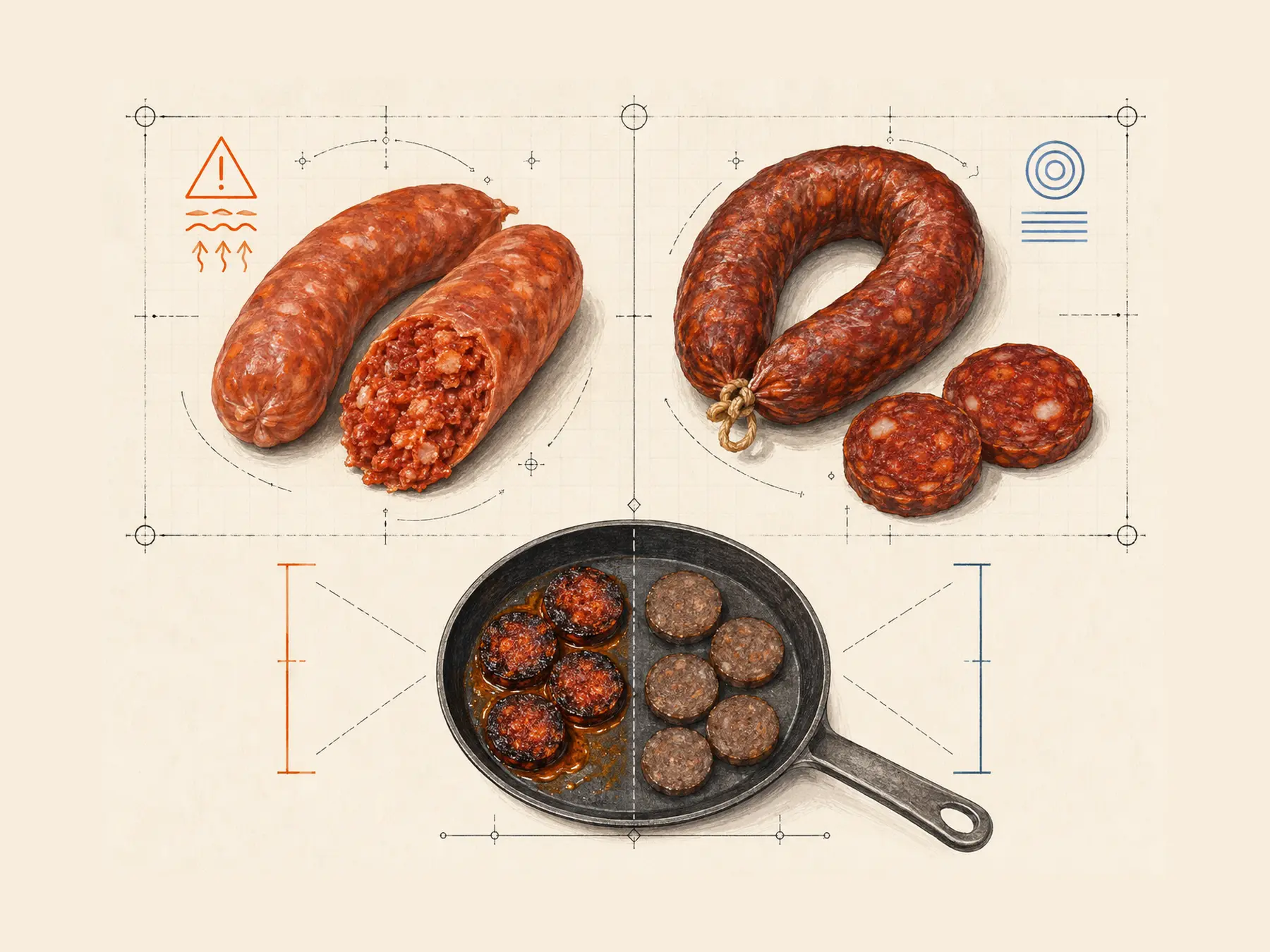
“Chorizo” can mean two products that look related but ask completely different things of the cook.
Cooking chorizo is fresh sausage. Cured chorizo has been dried until it is firm and is normally ready to eat. One needs to be cooked through for safety. The other can be sliced straight onto a board, although heating it can still make it useful in a recipe.
That distinction matters more than whether the label says mild, spicy, smoked or Spanish.
The quickest way to tell them apart
| Cue | Cooking chorizo | Cured chorizo |
|---|---|---|
| Texture | Soft, moist and sausage-like | Firm, dense and sliceable |
| Usual shape | Fresh links or small sausages | Ring, horseshoe, straight stick or slices |
| Storage | Usually refrigerated with a use-by date | Often stored in a cool, dry place before opening, with a best-before date |
| Packet wording | “Cook thoroughly” or a stated cooking time | “Ready to eat”, serving suggestions, or no required cooking stage |
| In the pan | Releases moisture and paprika-rich fat; stays sausage-like | Keeps a firmer bite and may crisp at the cut edges |
| Safe to eat uncooked | No | Usually, when the pack says it is ready to eat |
Shape is only a clue. Packaging wins.
If a product is soft, chilled and presented like an uncooked sausage, treat it as raw unless the label clearly says otherwise. If it is a firm dry-cured ring sold as ready to eat, cooking is optional rather than a safety requirement.
What curing changes
Fresh cooking chorizo retains much more moisture. Heat firms the meat, renders fat and releases seasoned juices into the pan. It is excellent when you want the sausage itself to remain juicy or when its paprika-rich fat is meant to become part of a sauce.
Cured chorizo has already lost moisture during drying. It begins firmer, slices cleanly and does not need heat to become edible. Frying can render some fat, intensify the seasoning and create crisp edges around a softer centre.
“Can” is doing useful work there. Curing does not guarantee that every ring will crisp in the same way.
Why two cured rings can behave differently
How a slice browns depends on more than the word cured.
Its remaining moisture, the grind of the meat, the casing, surface treatment, sugar, slice thickness, pan contact and manufacturing process can all affect what happens. Most of those details are not visible on a supermarket label.
This is where a confident-sounding explanation becomes tempting and unhelpful.
The two rings tested for Smoky Chorizo One-Pan Rice are both cured. Noel Smoked Chorizo repeatedly developed dark, crisp edges. Tesco Finest Spanish Chorizo went grey-brown and never reached the same texture.
The obvious theory would be that Noel contains more fat. The current labels do not support it: Noel lists 38g fat per 100g and Tesco Finest lists 40.3g.
So the honest conclusion is not that one ingredient explains everything. It is that two superficially similar cured rings behaved differently in the same home kitchen, and the Noel product produced the result the recipe needs.
What this recipe needs
Smoky Chorizo One-Pan Rice uses a cured ring, cut into chunky pieces.
The chorizo goes into the pan first, without the vegetables competing for space or releasing water. It cooks until the edges are deeply coloured and enough seasoned fat has rendered to build the rest of the dish.
Then every piece comes out.
That is not unnecessary plate juggling. If the chorizo simmers in stock for the entire rice stage, the crisp outside softens and the piece becomes one uniform texture. Returning it only at the end warms it without surrendering the contrast between crisp edge and softer middle.
Which one should you buy?
Buy cooking chorizo when you want a juicy fresh sausage: grilled, roasted, crumbled into a sauce or cooked whole.
Buy cured chorizo when you want clean slices, a firm bite, the option to eat it without cooking, or crisp pieces that can be removed and returned to a dish.
For this Plateworks recipe, use a cured chorizo ring you know will brown well. Noel Smoked Chorizo is the tested choice. That is a product result, not a law of chorizo.
And whatever the recipe says, read the packet. Two sausages sharing a name is confusing enough without guessing which one is raw.